

Unified Geohazard Intelligence Platform
Advancing the state-of-the-art in geohazard assessment and risk intelligence for mission-critical applications.
Mission-FirstGeohazard Intelligence
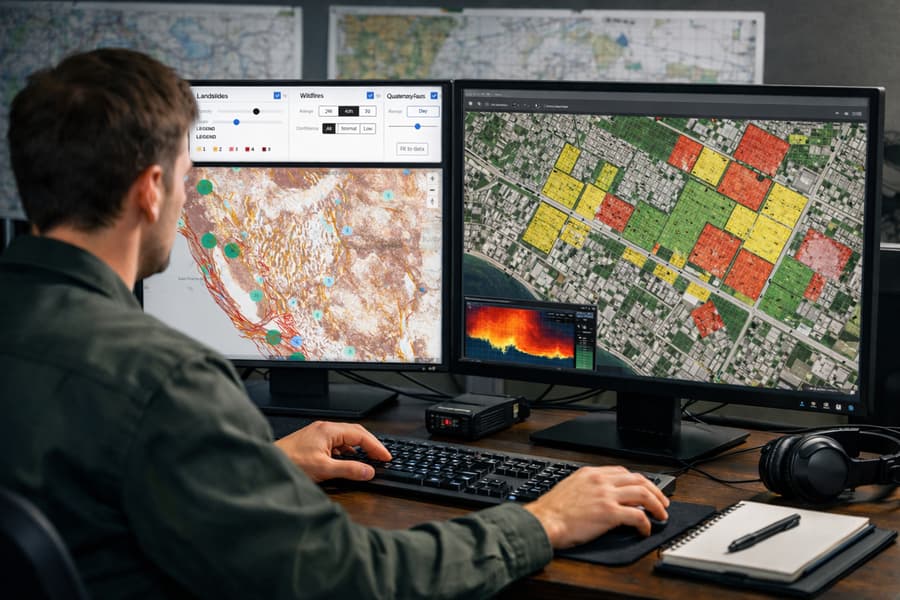
Designed specifically for the Department of War and critical infrastructure stakeholders, GeoLogix.ai is a cutting-edge geohazard assessment platform. Built on advanced geospatial intelligence and machine learning, GeoLogix provides unified, actionable insights into seismic risks, fault line mapping, wildfire threats, and other critical geohazards that could impact mission operations and asset protection.
Post-competitive and ready for rapid procurement without further competition.
Core Capabilities
GeoLogix integrates multiple geohazard datasets and advanced analytics to provide comprehensive risk assessment
Seismic Risk Assessment
Real-time monitoring and predictive modeling of seismic hazards with historical fault line data and modern sensor integration.
Fault Line Mapping
Comprehensive quaternary fault mapping and active fault identification supporting infrastructure planning and emergency preparedness.
Wildfire Threat Intelligence
Live wildfire tracking with predictive fire spread modeling and risk zoning for priority asset protection.
Unified Data Platform
Integrated geohazard data from multiple sources with customizable dashboards and real-time alert systems.
Mission Impact Analysis
Assess how geohazards could impact mission operations, supply chains, and critical infrastructure assets.
Decision Support Tools
Advanced analytics, scenario modeling, and actionable recommendations for operational planning and risk mitigation.
Interactive GeoLogix Demo
Explore the power of unified geohazard intelligence. The demo below shows real-time monitoring capabilities across multiple hazard types.
Built for the Mission
Cloud-native, secure architecture ready for rapid deployment across government and commercial environments
Infrastructure-as-Code
- •Automated Deployment
- •Repeatable Instantiation
- •Secure by Design
Security First
- •NIST SP 800-53 Controls
- •End-to-End Encryption
- •Continuous Compliance Monitoring
GovCloud Ready
- •IL2/4 Compliance
- •Deployable to USACE CWBI
- •Minimal Friction Fielding
DevSecOps
- •Rapid Secure Deployment
- •Modern Best Practices
- •Continuous Security
What makes GeoLogix stand out?
Purpose-built for geohazard intelligence—faster to value, easier to integrate, mission-ready
| Feature | ArcGIS-only (Esri) | Data platform + BI | Custom app (mapping SDKs) | General ops/integration platform | Geotech systems (records, boreholes) | Seismic hazard tools (hazard engines, shaking) | GeoLogix |
|---|---|---|---|---|---|---|---|
| Depth for geohazards | ⚠️Strong GIS. Limited geohazard fusion and mission workflows out of the box | ✗Strong data. Weak map-first operational geohazard decisioning | ✓Can be high, but only if you build it | ⚠️Broad. Geohazard depth usually requires tailoring | ✓Excellent geotech records. ✗ Limited enterprise hazard fusion | ✓Excellent hazard science outputs. ✗ Not end-to-end decision workflows | ✓Purpose-built geohazard fusion plus mission impact workflows |
| Time to value | ⚠️Weeks to months (custom build) | ⚠️Months (data engineering plus app layer) | ✗Months to a year | ⚠️Weeks to months | ⚠️Weeks to months (migration and standardization) | ✓Fast for hazard outputs. ⚠️ Slower to operationalize at scale | ✓Faster because workflows are recorded |
| Access/entry | ✓Already in many agencies | ✓Often already funded enterprise-wide | ✓Flexible. Any dev team can start | ⚠️Varies. Often heavyweight onboarding | ⚠️Often program-level, not enterprise | ✓Many are standard or publicly available | ✓Designed for quick evaluation and pilot path |
| Integration effort | ⚠️Medium to high (feeds, models, asset context, governance) | ✗High (geo fusion, alerting, UI, workflows) | ✗Very high (connectors, auth, audit, fusion, workflows) | ⚠️Medium to high (data modeling and operationalization) | ⚠️Medium (not designed as decision hub) | ⚠️Medium to high (asset context, exposure, workflows) | ✓Lower than build-from-scratch. API-first integration with authoritative sources |
| Maintenance burden | ⚠️High (custom apps and pipelines) | ✗High (pipelines plus separate map experience) | ✗Very high (you own product security and sustainment) | ⚠️Medium (platform-managed customization grows) | ⚠️Medium (strong records, weaker ops workflows) | ✓Low to consume outputs. ⚠️ Higher if you build enterprise decisioning | ✓Reduced. Product handles core patterns and updates |
| Evidence and credibility | ⚠️Typically internal. Outcomes depend on build quality | ⚠️Strong reporting. Weak operational proof unless built | ⚠️Depends on delivery maturity | ✓Often strong enterprise adoption, not always geohazard-specific | ✓Strong for compliance and records. Mixed for mission outcomes | ✓Strong scientific credibility. Less enterprise ops outcome proof | ✓Validated by DoW GeoTechnical SMEs |
| Best for | Teams building custom geohazard apps on enterprise GIS | Enterprise reporting and analytics | Unique UX needs where cost is acceptable | Cross-mission ops with many domains | Managing investigations, boreholes, subsurface records | Producing hazard layers, shaking maps, scenarios | ✓Decision-ready geohazard platform without multi-year build |
The Tradewinds Advantage for GeoLogix
GeoLogix is awardable on DoW's Tradewinds Marketplace, which means government agencies can contract with us directly—without issuing a new RFP or justifying a Sole Source. This streamlined procurement approach removes traditional barriers and enables rapid deployment of innovative technology to mission-critical applications.
Awardable on Tradewinds Solutions Marketplace
Post-Competitive Procurement Made Simple
GeoLogix has been assessed and deemed Awardable by the DoW's Tradewinds Solutions Marketplace, meaning it has already satisfied competition requirements. Government agencies can now contract directly with Solid Logix for GeoLogix without issuing a new RFP or conducting additional competition.
This "post-competitive" status streamlines procurement, reduces acquisition time from months to weeks, and allows agencies to leverage innovative geohazard intelligence capabilities immediately.

Fast-Track
Accelerated procurement timeline
Pre-Vetted
Solutions meet DoW standards
Flexible Terms
Adapt to mission requirements
Support
Ongoing vendor partnership
Simplified Procurement
About the Tradewinds Program
The Department of War's Tradewinds Solutions Marketplace provides government agencies with streamlined access to innovative solutions without the overhead of traditional acquisition processes.
Validated as a post-competitive, Awardable solution, GeoLogix.ai meets all DoW requirements and is positioned for seamless, rapid procurement.
- Simplified Procurement: Reduced bureaucracy and faster acquisition timelines
- Commercial Solutions: Access to pre-screened, mission-ready capabilities
- Flexible Contracting: Multiple engagement models and contract vehicles
- Government-Compliant: Full compliance with federal requirements and standards